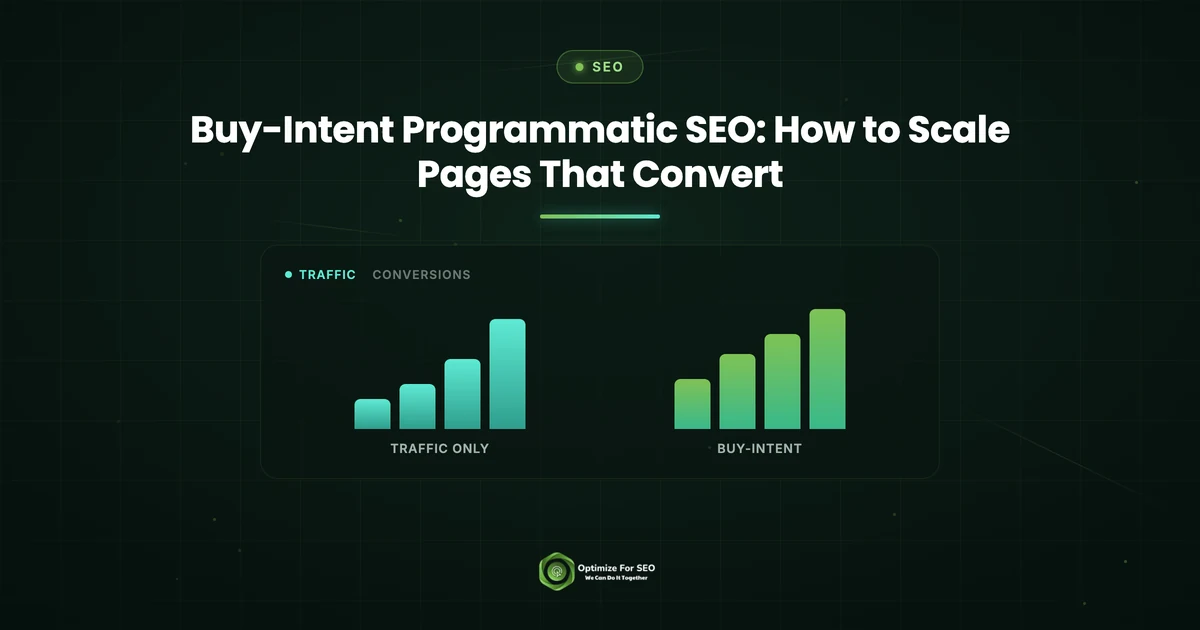
A SaaS founder showed us a dashboard last year with 4,000 indexed pages and a traffic line that climbed every month. The revenue line never moved. Almost every page answered something like "what is customer churn" or "how does email automation work." Visitors arrived, read a definition, and left. That gap, between pages that pull visitors and pages that pull buyers, is the entire reason buy-intent programmatic SEO exists.
Most programmatic SEO chases high-volume informational terms because they are easy to template and the search numbers look impressive in a report. The problem is that people searching "what is" are rarely ready to pay anyone. Buy-intent programmatic SEO flips the target: you build pages at scale around the commercial and transactional questions buyers ask right before they choose a vendor.
Why Buy-Intent Beats Raw Search Volume
Search volume and revenue are different metrics, and confusing them is the most expensive mistake in content SEO. A page ranking for a 50,000-impression informational term can convert worse than a page ranking for a 300-impression term with "best" or "pricing" in it. We have watched a single "best accounting software for contractors" page out-earn a dozen definition articles combined, because the handful of people who land on it are already reaching for a card.
Buyer questions carry intent in their wording. The modifiers give them away:
- best - the searcher is building a shortlist and comparing options.
- alternative - they already use or rejected a competitor and want a replacement.
- pricing or cost - they are past research and sizing the budget.
- vs - they are down to two or three choices and need a tiebreaker.
- for (a role or industry) - they want proof the product fits their exact situation.
These terms convert because the reader has already decided they need a solution. Your only job is to answer the comparison honestly and remove the last reason to hesitate. That is why pages built this way behave more like landing pages that convert and rank than like glossary entries.
What Buy-Intent Programmatic SEO Actually Targets
The craft of buy-intent programmatic SEO is picking the right page combinations, not maximizing the page count. A good template fuses three variables where the combination produces a genuinely different answer each time.
- The product or category the buyer needs (project management tool, running shoe, tax software).
- The customer type or use case (for agencies, for remote teams, for flat feet).
- The decision frame (best, alternatives to a named competitor, pricing compared).
Multiply those sensibly and you get pages like "best project management tools for agencies" or "cheaper alternatives to a named platform for small teams." Each one answers a real query from a real buyer, and each answer is actually distinct. Compare that to the lazy version where a script swaps one city name across 500 otherwise identical pages. The second approach is what gets sites buried, and we will come back to why.
Clustering these pages well also matters. A loose pile of comparison pages ranks worse than a tight set connected by a smart internal linking strategy and organized into topical authority content clusters so Google understands you own the subject.
The Dots Workflow, Described Honestly
The approach that made this popular recently is often called Dots, popularized by Borja Obeso. In plain terms, Dots is a way of running AI agents on a schedule to automate a buy-intent publishing workflow: the agents find buyer questions, group them, draft complete answers, and queue pages for publishing night after night.
Two honest caveats before you get excited:
- It is an approach, not an official product. It uses AI agents, an approach some brand as Dots. It is not a confirmed OpenAI product, so do not treat it as one.
- Automation is the easy 20 percent. Anyone can wire agents to publish. The hard part, and the part that decides whether you rank or get penalized, is judgment: which pages deserve to exist, whether the facts are true, and whether the price you quoted is still live.
The workflow itself is sound. Find buyer questions, group them by the decision the reader is making, build useful combinations, write complete answers, then automate the repetitive publishing. The danger is treating "automate" as "stop thinking."
Running It the Right Way: Real Value Per Page
We publish buy-intent pages at scale, but every page has to pass the same test a human editor would apply to a single flagship article. That discipline is the difference between a durable asset and a liability waiting for the next core update.
The rules we hold the pipeline to:
- Real value per page. If a page does not answer its query better than what already ranks, it does not ship.
- Verified facts and prices. Every claim, feature, and dollar figure is checked against the live source, because a wrong price on a comparison page destroys trust instantly.
- Human review before publish. AI drafts are raw material, not finished pages. A person approves each one.
- No thin or near-duplicate pages. If two pages would say the same thing, we merge them into one stronger page.
Done this way, the pages also perform well in AI answers, because the same qualities that satisfy a buyer, specific, current, trustworthy, are what help you rank inside Google AI Overviews. Good buy-intent content is simply the best SEO content for your site produced at a scale manual writing cannot match.
Also Read :- the real difference between SEO, AEO and GEO
We Build Buy-Intent Programmatic SEO For You
Scaling pages that convert is not about a clever script. It is about a repeatable system where research, templating, fact-checking, and human review all run together without quality dropping on page 400. Most teams either publish too little by hand or publish too much without checks and get hit. There is a disciplined middle path, and it is where the revenue lives.
Our SEO services agency team builds and runs this pipeline end to end: we mine your buyer questions, design templates that add real value per page, verify every fact, and keep a human in the loop on approvals. If you sell online and need comparison and attribute pages that move product, our ecommerce SEO services apply the same approach to catalog-scale pages. Want to see whether your site is a fit? Talk to our team about your goals and we will tell you honestly.
Keep Reading on Buy-Intent Programmatic SEO
- how to find buy-intent pSEO opportunities
- programmatic SEO without the thin-content penalty
- using AI agents to automate SEO content
- where to publish to get cited by AI
- where buy-intent pSEO actually works
Frequently Asked Questions
What is buy-intent programmatic SEO in simple terms?
It is building pages at scale that target commercial and transactional searches, the "best," "alternative," "pricing," "cost," and "vs" questions buyers ask near a purchase, instead of high-volume informational terms that rarely convert. The point is pages that earn revenue, not just impressions.
How is it different from normal programmatic SEO?
Normal programmatic SEO usually optimizes for search volume and page count. The buy-intent version optimizes for the reader's position in the buying journey. Fewer pages, higher intent, and a conversion rate that justifies the effort.
Is the Dots approach safe to use?
The Dots approach, AI agents running a scheduled publishing workflow, is only as safe as the controls around it. Used with human review, verified facts, and genuinely distinct pages, it is fine. Used to mass-publish unchecked drafts, it becomes the scaled content abuse Google penalizes.
How many pages should a buy-intent campaign have?
Only as many as can answer a real, distinct query with real value. That might be 40 pages or 4,000, depending on how many genuinely different buyer questions your market actually has. Padding the count with near-duplicates hurts you.
Will these pages still work as AI search grows?
Yes, often better. AI answer engines favor specific, current, trustworthy content, which is exactly what a well-run buy-intent page is. Pages that help a buyer decide are also the pages most likely to get cited in AI Overviews and chat answers.
Want this handled for you? Our SEO services agency can help you grow your organic traffic and revenue.
Aashirvad Kumar
Writes about SEO, digital marketing and growth at Optimize For SEO.